
Starting a business as an expat in Germany can feel like navigating a maze of paperwork, long compound German words, and strict regulations. I recently went through the entire process of registering my own side business (Nebenerwerb) while working full-time as a nurse. If you are a content creator, blogger, or digital marketer looking to make your business official, here is exactly how the process works, based on my real-life experience in Chemnitz, Saxony.
The Backstory: From Freelancer to Gewerbe (A Plot Twist!)
My journey didn’t actually start at the Trade Office (Gewerbeamt). It started with a book.
Initially, I wanted to self-publish my own books on Amazon KDP. Believing this fell under pure freelance artistic work (Freiberufliche Tätigkeit), I went straight to the online tax portal, ELSTER, and submitted the Fragebogen zur steuerlichen Erfassung (Tax Registration Questionnaire) to notify the Finanzamt. They approved my registration, and I successfully published my first book: Resilient Kindness. 👉 Discover “Resilient Kindness” on Amazon

However, as I started planning to expand into digital content creation and affiliate marketing, I realized German law has a very fine line between what is considered a “pure freelance profession” and what counts as a commercial trade (Gewerbe).
The Email That Got Stuck
I wanted to be 100% sure about my legal standing, so I drafted an email to the Chemnitz city authorities to ask if my self-publishing and marketing plans required a trade license. Days passed, and my email got stuck in a digital queue with no response.
Going in Person (The Best Decision)
Realizing that German bureaucracy sometimes moves faster face-to-face, I booked an appointment and went to the office in person. The city officers were incredibly helpful, patient, and guided me carefully through the next steps. A few weeks after my visit, I received a follow-up email confirming that because my digital activities involved intent to sell products, I had to officially register a Gewerbe.
The “Backdating” Panic
When I read that email, panic set in. I had already been selling my book for a while under my freelance tax number. I was genuinely afraid I would face heavy penalties or fines for operating a commercial business without a trade license beforehand.
Thankfully, the officer was incredibly reassuring. He explicitly told me in his email not to worry and instructed me to simply backdate my trade registration to January 1, 2026—matching the exact start date I had previously given to the Finanzamt. He also advised me to send the documents directly to him as he is aware of my circumstance.
Step 1: Getting Employer Permission First
Before filling out a single government form, there is a golden rule in Germany: If you work full-time, you must notify your employer before starting a side hustle. Because I work in a hospital, my employment contract requires me to report any side activities (Nebentätigkeit). Your employer generally cannot forbid you from starting a digital business unless it directly competes with them or hurts your work performance. However, you must respect the German Working Hours Act (Arbeitszeitgesetz):
Your combined working time (main job + side hustle) shouldn’t permanently cross 48 hours per week.
You must maintain an 11-hour rest period between finishing your side work and starting your next shift at your main job.
Tip: Get your employer’s written approval filed away safely before you head to the trade office!
Step 2: The Business Registration (Gewerbe-Anmeldung)
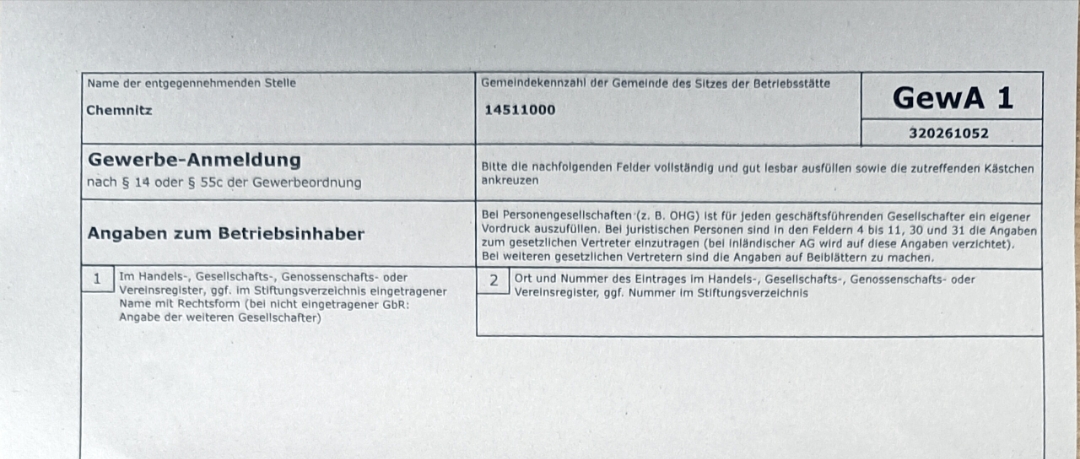
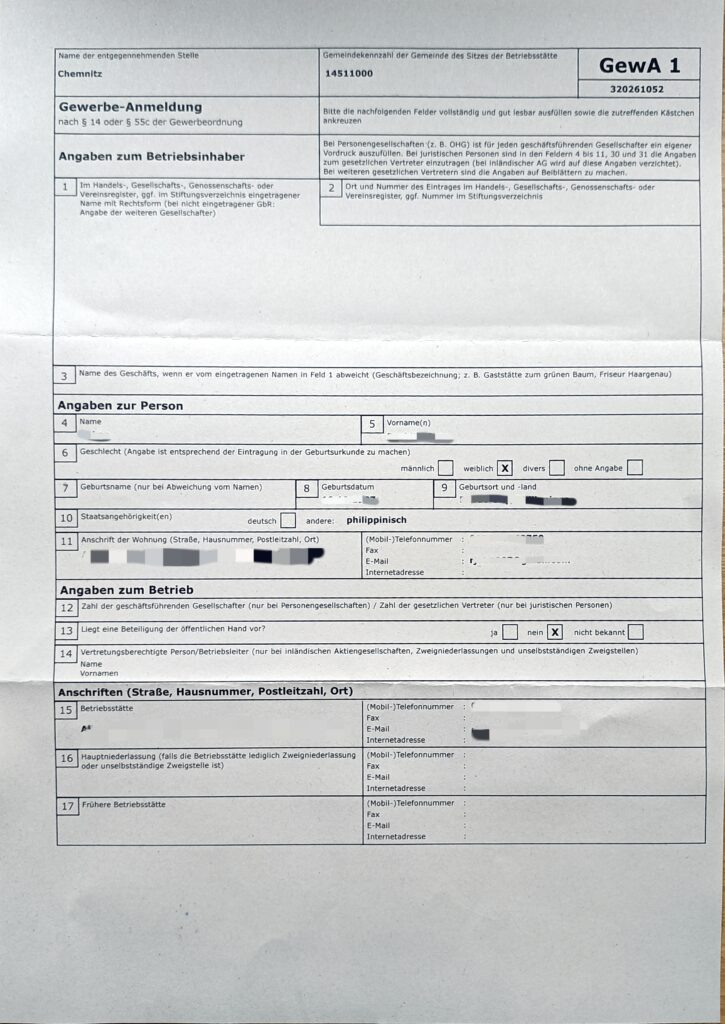
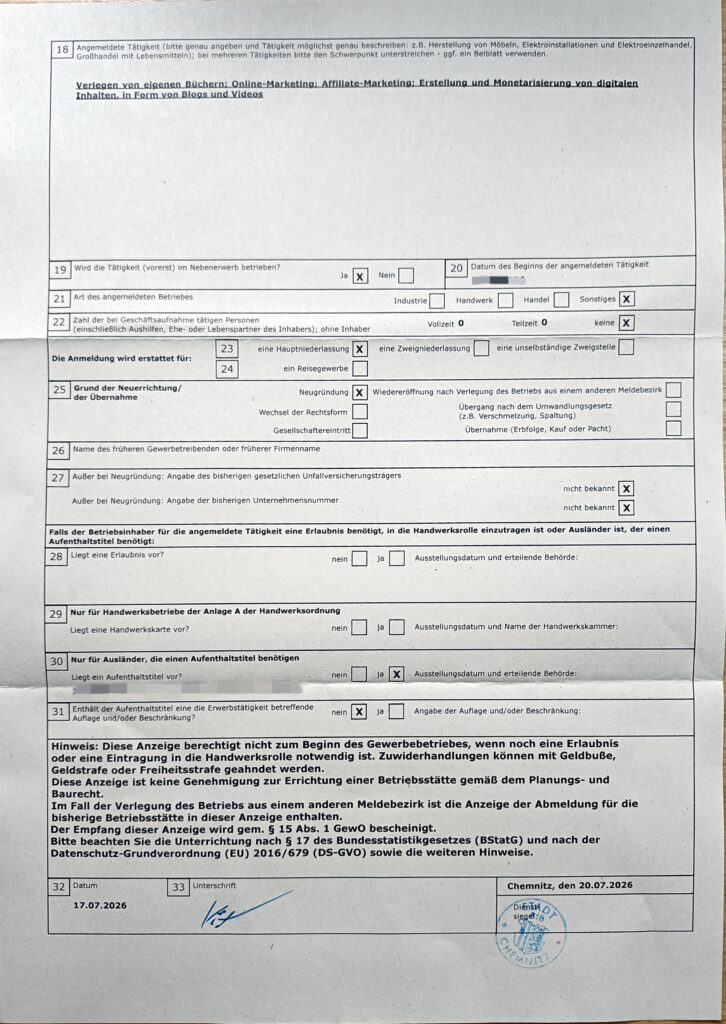
With my employer’s permission in hand and the officer’s advice, I officially submitted my registration using the form called GewA 1. Here was mine after being approved. Small Tip 🌟 Make sure to send two copies if you have to mail it in.
What to Fill In:
The Business Activities (Box 18):
Be specific about what you do. For my digital business, I registered for: Publishing my own books, Online-Marketing, Affiliate-Marketing, and the creation/monetization of digital content via blogs and videos.
Part-Time Status (Box 19):
Make sure to check “Ja” for Nebenerwerb (Side Business). This tells the authorities this is not your primary source of income.
Residency Status (Boxes 30 & 31):
As a non-EU citizen (holding a Philippine passport), the trade office verified my residence title (Aufenthaltstitel). Your visa must explicitly state that self-employment is permitted (Erwerbstätigkeit/Selbstständige Tätigkeit gestattet). Once processed, the city stamped my form, making it officially active!
Step 3: Paying the Registration Fee
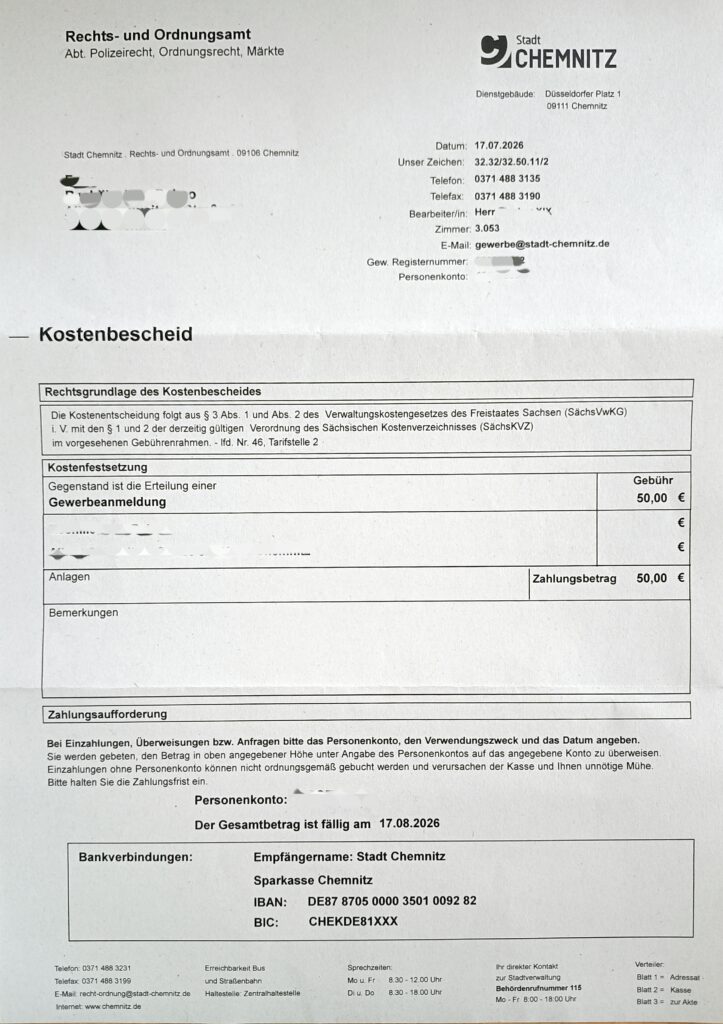
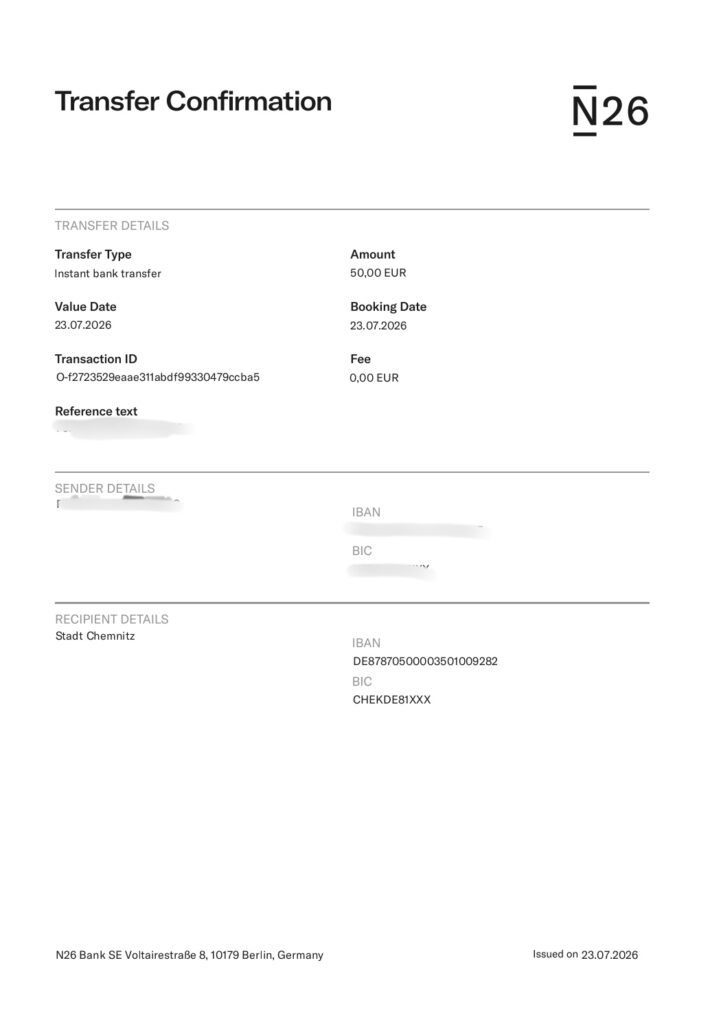
A few days after registration, you will receive an official invoice (Kostenbescheid) from the city. In Chemnitz, the registration fee was exactly 50,00 €. Here was mine:
Important Payment Rules:
No Credit Cards:
German municipal offices generally do not accept direct card payments for mailed invoices. You have to do a traditional bank transfer (Überweisung).
Use a Business Account:
If you have an account like N26 Business, transfer the money directly from there. It keeps your personal and business expenses strictly separated.
The Reference Code:
You must input the exact account reference number (Personenkonto) in the transfer details so the city’s automated system can match your payment.
Tax Write-Off:
Keep this invoice! The €50.00 fee is fully tax-deductible as an anticipated operating expense (vorweggenommene Betriebsausgabe). Here’s mine:
Step 4: Notifying Health Insurance (AOK PLUS)
In Germany, your health insurance company needs to know if you are earning money on the side. Because my primary insurance is already fully covered by my full-time nursing salary, a side business won’t automatically increase my premiums—but I still had a legal duty to inform them.
How I Did It Digitally:
1. Logged into the “Meine AOK” online portal.
2. Selected the “Dokument einreichen” (Submit Document) option.
3. Chose the general “Sonstiges” (Other) category.
4. Uploaded a clean photo of Page 2 of my Gewerbe-Anmeldung (the page showing the Nebenerwerb checkbox and the official city stamp).
What Happens Next?
AOK PLUS will review the document and send an official questionnaire in the mail or portal. This form will explicitly ask how many hours per week I plan to work on the business. As long as it remains under 20 hours per week and the income doesn’t overshadow my main salary, it remains classified as a side job, and no extra insurance fees apply.
Step 5: What’s Next? (The Tax Office)
Now that the city and health insurance are updated, the final piece of the puzzle is the Tax Office (Finanzamt). The trade office automatically alerts them when you register a business. In the coming weeks, I expect a letter prompting me to log into ELSTER to fill out the Fragebogen zur steuerlichen Erfassung (Tax Registration Questionnaire).
This is where I will opt for the Kleinunternehmerregelung (Small Business Regulation) to keep my bookkeeping simple and exempt myself from charging 19% VAT, since my first-year revenue will easily be under the €22,000 threshold.
Final Thoughts
Taking your business legal in Germany looks intimidating at first glance, but if you take it step-by-step—Employer ➡️ City ➡️ Insurance ➡️ Tax Office—it is entirely manageable. Going in person to ask questions saved me a lot of stress, and the friendliness of the local authorities in Chemnitz and members of Fablab Chemnitz made a huge difference.
Now that the Gewerbeamt has updated my profile, the city will automatically notify the Finanzamt to link my freelance book sales and my new marketing activities together under the Kleinunternehmerregelung (Small Business Regulation), keeping my bookkeeping beautifully simple.
What was your biggest paperwork hurdle? Let me know in the comments below!
Leave a Reply